By Mr Horecan | www.mrhorecan.com
Introduction
Tourism is often hailed as a tool for economic transformation, yet its true success lies not in the number of arrivals alone, but in the environment that sustains it. As a tourism researcher and practitioner, I have become increasingly wary of how tourism statistics are presented—particularly in countries grappling with insecurity. In regions like Nigeria, where movement is often by necessity rather than leisure, we must ask: Is what we’re witnessing truly tourism, or just travel?
This reflexive study, structured using Gibbs’ Reflective Cycle, explores this question critically by comparing Nigeria’s statistical underperformance with The Gambia’s security-led tourism growth—using verified data from the Nigerian Bureau of Statistics (NBS), UN Tourism, and the World Travel & Tourism Council (WTTC).
Description
In 2024, Nigeria recorded approximately 1.2 million international arrivals, yet over 90% of these were returning diaspora, visiting friends and relatives (VFR), or on non-leisure travel (NBS, 2024; WTTC, 2025). Meanwhile, The Gambia, with a population of under 3 million, welcomed 230,000+ international leisure tourists, who contributed approximately 16.9% of national GDP (GBoS, 2024; UNWTO, 2025).
At first glance, Nigeria’s tourism revenue is cited at $8.2 billion in 2024. However, this figure is misleading: it aggregates domestic travel, political movement, and non-leisure expenditures (WTTC, 2025). This inflates the perceived success of the industry while masking its vulnerabilities.
As a professional committed to sustainable and Pro-Poor Tourism (PPT), this pattern is troubling. It fosters a false narrative of progress while masking foundational failures—namely, poor safety, data distortion, and limited local benefit. I feel a strong obligation to redirect the conversation—from arrival statistics to meaningful impact.
Tourism is a discretionary activity. People choose where to travel based on how safe, hospitable, and fulfilling a destination feels. When insecurity dominates perception—as it does in Nigeria—tourism stagnates. Research confirms that perceived insecurity is one of the most powerful inhibitors to tourism growth (Zou, 2022; Manrique-de-Lara-Peñate, 2022).
In The Gambia, however, stable governance, targeted marketing, and physical security have built real trust. Tourists arrive not out of obligation, but desire—resulting in stronger foreign exchange earnings and wider community impact.
Analysis
The data makes a sharp contrast:
| Metric | Nigeria (2024) | The Gambia (2024–2025) | Source |
|---|---|---|---|
| International Arrivals | ~1.2 million (mostly diaspora/VFR) | 230,000+ leisure tourists | NBS, 2024; GBoS, 2024 |
| Tourism GDP Contribution | <0.3% | ~16.9% | WTTC, 2025 |
| Primary Barrier | Insecurity, poor perception | Market diversity, seasonal gaps | UNWTO, 2025 |
| Tourism Revenue | $8.2B (mostly domestic/VFR) | ~$0.5B (largely foreign receipts) | WTTC, 2025 |
What’s more revealing is the quality of these revenues. When broken down:
Tourism Revenue Per Tourist
- Nigeria: ~$6,833
- The Gambia: ~$2,174
Note: Nigeria’s figure is inflated due to low inbound leisure traffic and high reliance on domestic/diaspora expenditure (WTTC, 2025).
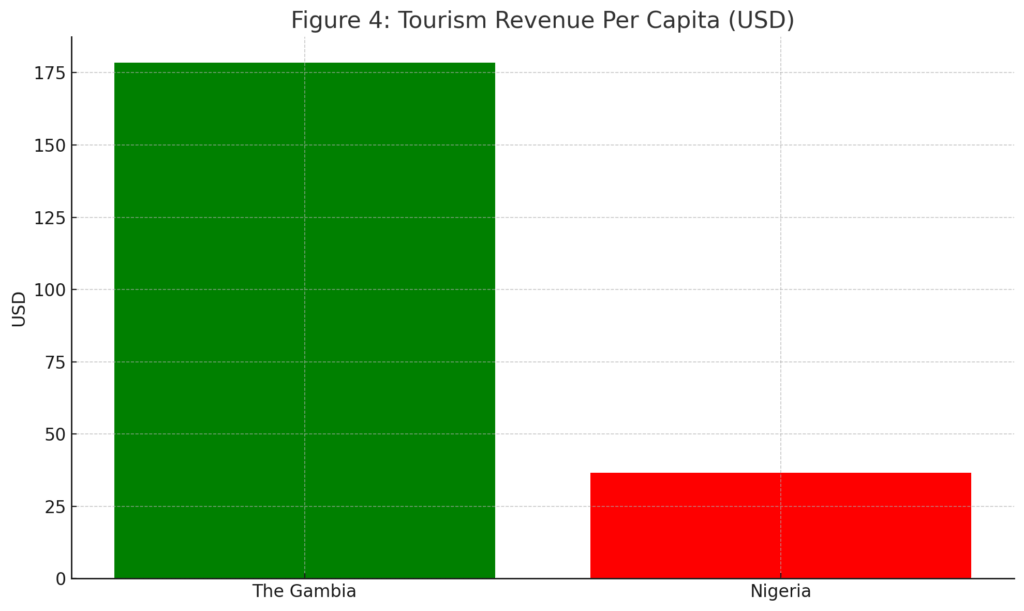
Tourism Revenue Per Capita
- Nigeria: ~$36.64
- The Gambia: ~$178.57
(WTTC, 2025; World Bank, 2025 population estimates)
Interpretation: Nigeria appears to earn more per “tourist” only because most of its “tourists” are actually locals or returning citizens. The Gambia, meanwhile, earns more per capita and more from real leisure tourists, making its tourism revenue export-driven and transformative.
Insight: Tourism Impact Comparison
Figure 1: GDP Contribution of Tourism (% of National GDP)
Nigeria: 0.3%
(Source: WTTC, 2025)
The Gambia: 16.9%
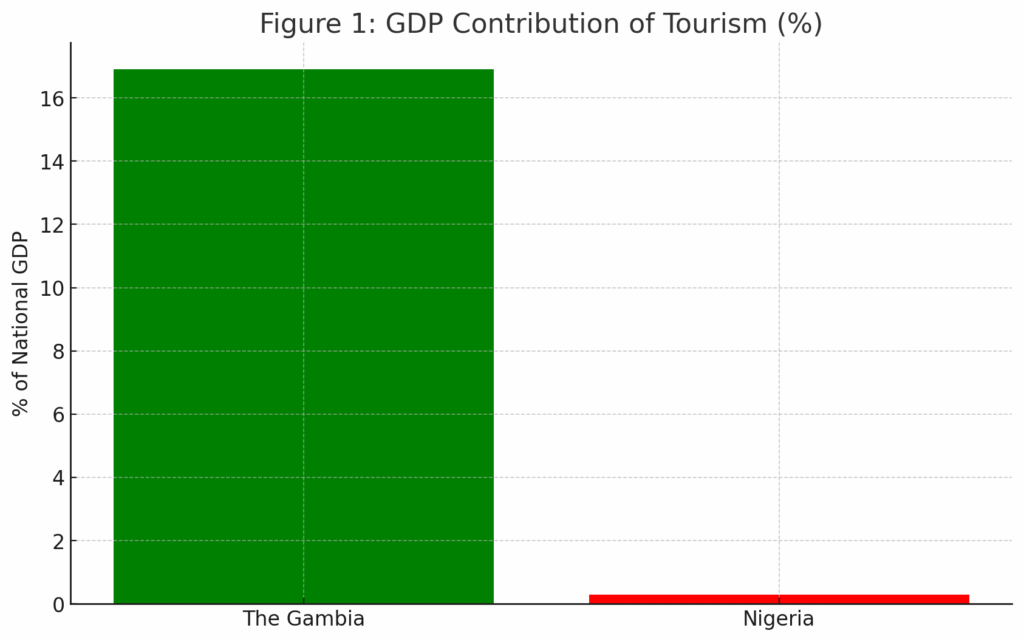
Figure 2: International Tourist Arrivals
- The Gambia: 230,000+ (leisure travelers)
- Nigeria: 1.2 million (mostly diaspora/VFR)
(Source: UNWTO, 2025)
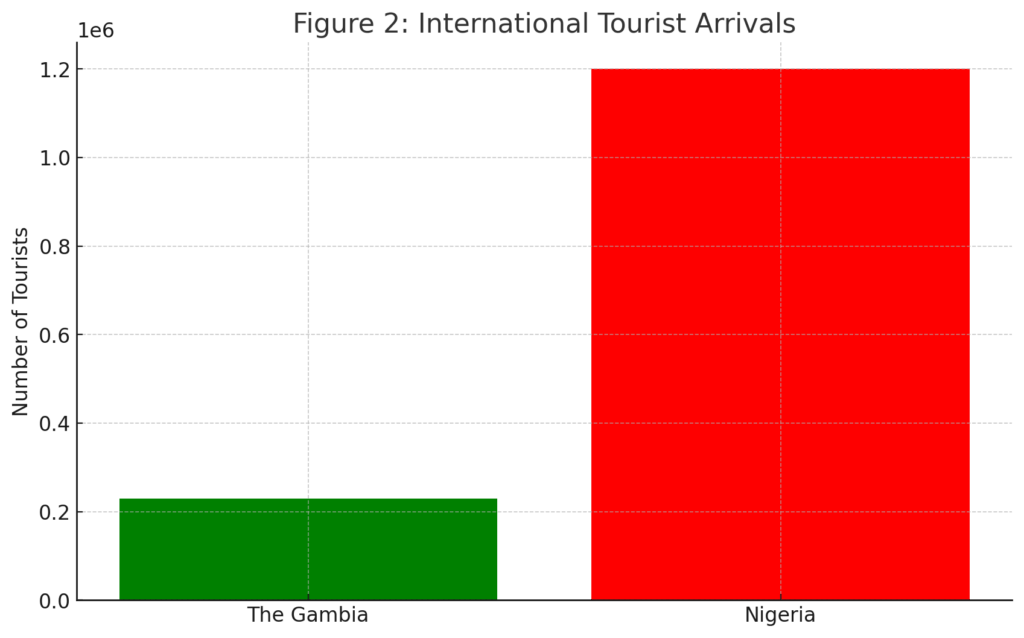
Figure 3: Revenue Per Tourist (USD)
- Nigeria: $6,833 (inflated by non-leisure travel)
- The Gambia: $2,174 (from real leisure tourism)
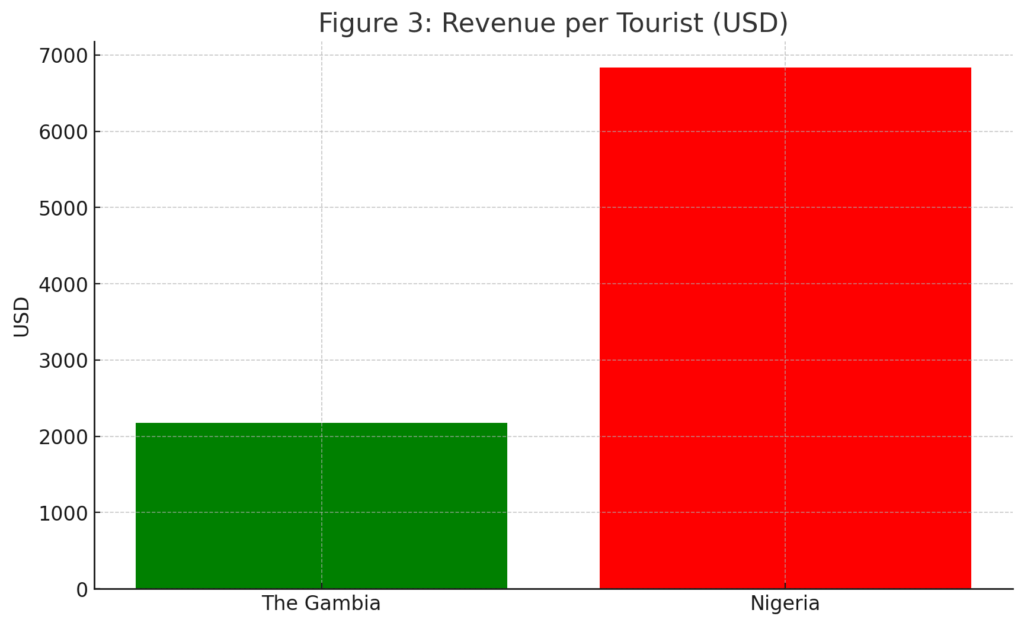
Figure 4: Tourism Revenue Per Capita (USD)
- Nigeria: $36.64
- The Gambia: $178.57
Conclusion
Critically reflecting on the data and realities, the answer is clear: tourism cannot truly thrive in an insecure country. Without safety, systems, and strategy—the S–S–S Framework—Nigeria’s potential will remain just that: potential. While it boasts rich heritage, biodiversity, and cultural capital, these assets cannot shine under the cloud of violence, poor perception, and policy fragmentation.
In contrast, The Gambia proves that size is not destiny. Through smart governance and commitment to safety, it has positioned itself as a high-performing leisure destination with measurable benefits to its people.
Action Plan for Fragile States Like Nigeria
To convert potential into prosperity, Nigeria must:
- Prioritize localized security reform to restore trust in destinations.
- Invest in systems: digital infrastructure, hospitality training, transparent data collection.
- Separate diaspora and VFR from actual leisure tourism in statistical reporting.
- Embed Pro-Poor Tourism (PPT) into national tourism strategies to directly benefit communities.
Until these are in place, tourism in Nigeria will continue to operate beneath its promise—over-represented in metrics but under-delivering in development.
References (Harvard Style)
Akamavi, R.K. (2023) ‘Tourism and Troubles: Effects of Security Threats on the Tourism and Allied Sectors’, Journal of Travel Research, 62(1).
Gambia Bureau of Statistics (2024) ‘Tourism Annual Report’. Available at: https://www.gbosdata.org/
Manrique-de-Lara-Peñate, C. (2022) ‘The economic impact of global uncertainty and security threats on tourism’, Economic Modelling, 113.
Nigerian Bureau of Statistics (2024) ‘Nigerian Tourism Statistics 2023/2024’. Available at: https://www.nigerianstat.gov.ng/
United Nations World Tourism Organization (2025) ‘International Tourism Highlights, 2025 Edition’. Available at: https://www.unwto.org/
World Travel & Tourism Council (WTTC) (2025) ‘Travel & Tourism Economic Impact: Nigeria & Gambia’. Available at: https://www.wttc.org/
Zou, Y. (2022) ‘Sense of safety toward tourism destinations: A social psychological perspective’, Tourism Management, 88.