Introduction
Titanic Belfast offers a globally significant model in how dark heritage sites can be ethically reinterpreted to promote not only tourism but also collective memory, cultural identity, and post-industrial regeneration. As an immigrant and academic exploring the intersections of tourism, heritage, and social inclusion, my engagement with Titanic Belfast reveals how memory work and ethical storytelling can reshape public narratives, foster inclusive cultural development, and—most inspiringly—help a destination reclaim its heritage for its people.
This reflection also draws upon my advocacy for Pro-Poor Tourism (PPT), a framework ensuring that tourism benefits reach local communities and marginalized groups. Through that lens, Titanic Belfast becomes more than a visitor attraction; it becomes a case study in how history, place, and people can be reconnected through equitable tourism design.
Historical Context
Historically, Belfast’s relationship with the RMS Titanic was characterized by silence and disassociation. For much of the twentieth century, the city distanced itself from the maritime disaster of 1912, perceiving the ship’s fate as a source of embarrassment rather than pride (Kenneally, 2019). The Harland & Wolff shipyard, once a symbol of industrial might, gradually faded from public consciousness, compounded by wider deindustrialization and the political violence of The Troubles.
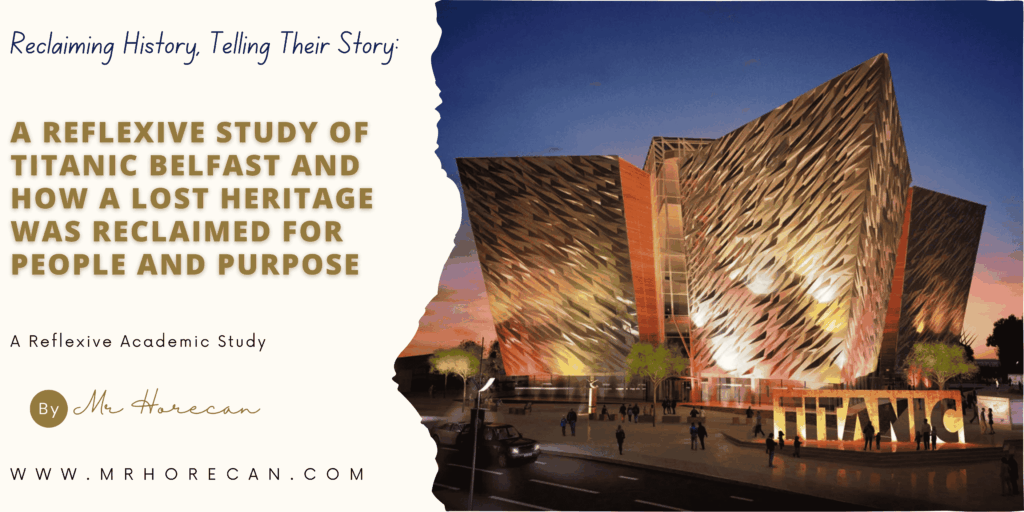
The narrative began to shift in the 1990s, especially following the international success of James Cameron’s 1997 film Titanic. The film reignited global interest but presented a romanticized version that largely omitted Belfast’s role (dark-tourism.com, 2021). In response, a new cultural movement emerged to reclaim this neglected heritage. This culminated in the development and opening of Titanic Belfast in 2012—a €100 million landmark project that transformed Queen’s Island, the historic site of the ship’s construction, into an immersive, critically engaged visitor attraction.
Heritage Reclamation and Inclusive Narratives
More than a museum, Titanic Belfast is a heritage-led regeneration initiative designed to foreground Belfast’s shipbuilding legacy while acknowledging the emotional and global significance of the disaster. The exhibition integrates interactive storytelling, multisensory galleries, and ethical curatorial practices that trace not only the Titanic’s lifecycle but also Belfast’s working-class identity and the city’s experience of deindustrialization (Belfast Heritage & Deindustrialization Report, 2019).
This inclusive approach echoes a key principle of Pro-Poor Tourism—that communities closest to heritage should not be left behind by the tourism that emerges from it. As Charters (2018) observes, Titanic Belfast’s interpretive strategy deliberately reframes the narrative from one of global tragedy to one of local resilience, allowing residents to see themselves not as victims of history but as custodians of it. By engaging former shipyard families, local historians, and artisans in the interpretive process, the attraction ensures that the voices of those who built the ship are finally heard. The project thus rebalances cultural power: it shifts focus from global tragedy to local contribution, creating both emotional ownership and economic opportunity for residents.
Economic Regeneration and Social Impact
Titanic Belfast was conceived within a broader strategy of culture-led urban regeneration in post-conflict Belfast. It contributes to the city’s transition from a site of political strife to a vibrant destination for heritage tourism. Within its first nine months, Titanic Belfast attracted over 650,000 visitors and has since become one of the most visited attractions on the island of Ireland (Ireland.com, 2023).
Its success demonstrates how reclaiming a difficult history can stimulate economic recovery, catalyse local enterprise, and build civic confidence—outcomes that align with the Pro-Poor Tourism framework. For nearby communities, the influx of visitors has generated demand for accommodation, transport, catering, and creative services, extending the tourism value chain beyond the museum walls.
In that sense, Titanic Belfast functions as a heritage-economy ecosystem. It transforms intangible narratives into tangible livelihoods, proving that heritage tourism, when designed with purpose, can contribute directly to inclusive growth and poverty alleviation.
Policy and Planning Perspective
From a policy standpoint, Titanic Belfast reflects the strategic integration of tourism development, urban planning, and cultural diplomacy. Situated within the larger Titanic Quarter redevelopment zone, the centre aligns with the goals of Tourism Northern Ireland and Invest NI to position Belfast as a premier tourism destination (Tourism NI Innovation Case Studies, 2020).
Here again, the project exemplifies how inclusive tourism policy can embed Pro-Poor Tourism principles even in advanced economies. The design encouraged collaboration between public agencies, private investors, universities, and local communities—an approach developing destinations can adapt. For emerging markets in Africa, this presents a transferable model: heritage can serve both remembrance and redistribution when policy deliberately connects investment to community outcomes.
Ethical Complexities and Reflexive Learning
Titanic Belfast is not without ethical complexities. Scholars have raised important questions about the commodification of tragedy and the risks of “disaster voyeurism” in dark tourism (Stone, 2006; Boyd, 2013; Charters, 2009). While Titanic Belfast avoids sensationalism through its focus on authenticity and local narratives, the challenge of balancing commercial sustainability with respectful commemoration remains (Zhang et al., 2015).
As a tourism scholar, I see these tensions as vital teaching tools. They reveal that heritage tourism—especially in post-conflict or post-industrial contexts—must constantly navigate moral boundaries. Reflexivity, humility, and stakeholder dialogue are essential in preventing exploitation of the very communities whose stories sustain tourism.
Reflexive Reflection
As a researcher and advocate for Pro-Poor Tourism, my engagement with Titanic Belfast goes beyond admiration for its design or visitor success. It represents a living classroom for inclusive tourism—where the past meets the present to inspire social innovation. By consciously including local people in narrative reconstruction, Titanic Belfast embodies the essence of tourism for people and purpose.
The site’s evolution from an abandoned dock to a global heritage icon exemplifies how storytelling, place-making, and community participation can redefine tourism’s purpose—not merely as an industry, but as a mechanism for healing, dignity, and empowerment.
Conclusion
Titanic Belfast teaches us that even the darkest chapters of history can illuminate pathways to renewal, equity, and shared prosperity. Its transformation from a symbol of industrial loss into a beacon of cultural pride underscores how ethical remembrance, design innovation, and social inclusion can coexist.
For Pro-Poor Tourism advocates like myself, it offers a deeper lesson: tourism achieves its highest moral value when it uplifts the people whose histories it tells. The challenge for developing destinations is not only to attract visitors but to ensure that tourism becomes a genuine engine of community advancement.
Ultimately, Titanic Belfast stands as both a monument and a metaphor—proof that when people reclaim their story, they also reclaim their humanity.
References
- Ashley, C., Roe, D., & Goodwin, H. (2001). Pro-Poor Tourism Strategies: Making Tourism Work for the Poor. Overseas Development Institute.
- Belfast Heritage & Deindustrialization Report (2019). Class, Heritage, and Space in Titanic Belfast.
- Boyd, S. (2013). Dark Tourism and the Politics of Memory. SAGE Publications.
- Charters, S. (2009). The Commodification of Tragedy: Dark Tourism and the Titanic Story. Annals of Tourism Research, 36(3), 536–558.
- Charters, S. (2018). Interpreting the Titanic: Dark Heritage, Memory, and Place Identity. Journal of Heritage Tourism, 13(2), 85–102.
- dark-tourism.com (2021). Titanic Belfast Experience.
- Ireland.com (2023). Belfast’s Titanic Legacy.
- Kenneally, R. (2019). Memory, Heritage and Shipyard Deindustrialization in Belfast. History Workshop Journal.
- Stone, P. (2006). A Dark Tourism Spectrum: Towards a Typology of Death and Macabre Related Tourist Sites, Attractions and Exhibitions. Tourism, 54(2), 145–160.
- Tourism NI (2020). Innovation Case Studies and Titanic Quarter Destination Action Plan.
- Zhang, H., Fyall, A., & Zheng, Y. (2015). Navigating Ethical Dilemmas in Dark Heritage Tourism. Atlantis Press.